
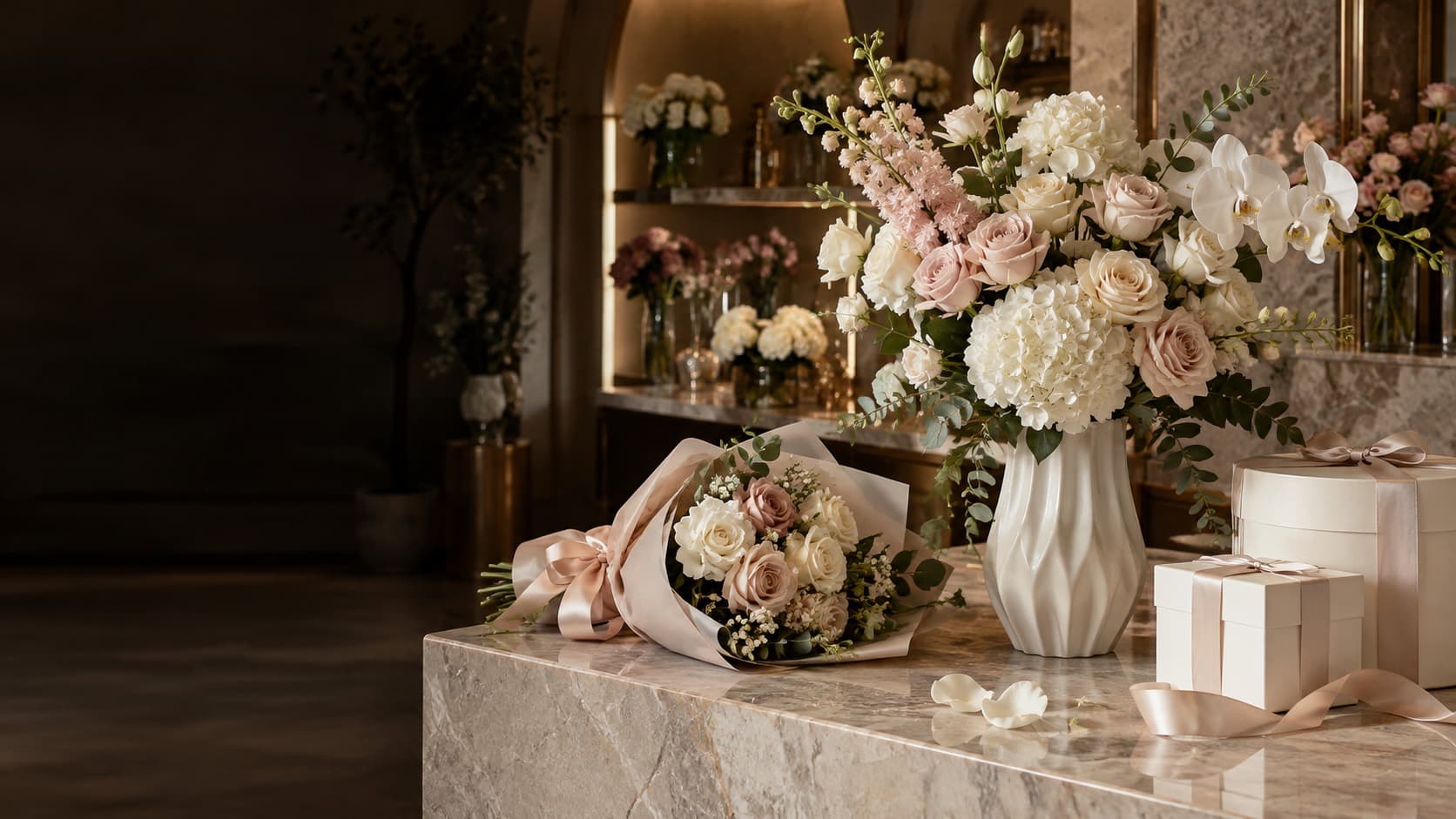
Build a credible luxury flower shop website with consistent photography, clear arrangement options and thoughtful design. Explore AMZ’s floral Shopify work.
The practical answer: make the brand believable before asking for payment
A luxury flower shop website should make the quality of the arrangement, the identity of the florist and the service promise easy to understand. Design builds trust when photographs, descriptions, packaging and delivery information reinforce each other. Decoration alone cannot establish that confidence.
For Dubai floral businesses, a useful design brief starts with the actual customer experience: what the recipient receives, how a buyer chooses and how the team handles questions. This article focuses on brand presentation and visual decision-making. Our separate conversion guide covers the wider purchasing journey and checkout friction.
The aim is not to make every flower store look identical. It is to build a recognisable digital expression of the florist's real work, supported by information customers can check.
Write the visual brief before choosing a theme
Define what makes the floral brand distinctive in observable terms. It may be sculptural arrangements, restrained wrapping, a particular colour approach or a personal consultation service. Choose a few genuine characteristics and use them to guide photography, typography, spacing and page hierarchy.
An expensive-looking template is not a substitute for this brief. A store selling expressive, colourful bouquets may need a different presentation from one built around minimal arrangements. Design should make the offer clearer, not impose an unrelated aesthetic.
Agree which elements must remain consistent across the website, social creative and packaging. Customers should recognise the same business after clicking an advertisement or receiving the finished gift.
- What arrangement styles can the team reproduce consistently?
- What packaging will the recipient actually receive?
- Which products or services should define the first impression?
- Which brand claims can be supported by real examples?
Create a photography system, not a collection of unrelated images
Plan images as a repeatable system. For each important arrangement, consider a clean overall view, a detail view and a photograph that helps establish scale. Keep lighting, background treatment and colour rendering consistent enough for customers to compare products.
Show wrapping, containers and add-ons accurately. If an accessory is used only for styling, say so where the customer makes the decision. A photograph should not imply that a vase, card or extra item is included when it is not.
Commission or capture authentic product images for the florist's catalogue. AI-generated editorial images can illustrate a blog, but they should not be presented as the exact arrangement a customer will receive, a client testimonial or evidence of a completed event.
Make the first screen explain the offer, not just the atmosphere
A homepage hero can introduce the brand, but it should also answer a useful question. What does the florist sell, where can it deliver and what should the visitor explore next? A beautiful photograph with a vague slogan may leave these decisions unresolved.
Use a clear heading and a purposeful route into the catalogue or consultation service. Keep essential wording as accessible page text rather than embedding it inside a decorative image. This also makes the message available to search engines and AI systems that read the page.
Choose motion carefully. A video can demonstrate craftsmanship, but autoplay, long loading times or obscured navigation can interrupt the experience. Retain useful media while giving customers a clear, stable path through the site.
Present arrangement options so the customer can compare honestly
Product names can convey style, but they should not replace concrete details. Explain arrangement format, approximate size where known, available variants, included packaging and any meaningful limitations. Shopify provides product information, media and variant fields that can support a consistent catalogue.
Use comparable images for size or format options where practical. If the same image represents multiple variants, explain the limitation instead of letting the buyer assume that every option is pictured. Avoid a premium label that has no clear relationship to the product.
Fresh flowers vary. Set an honest substitution policy that explains the intended approach without promising identical stems in every order. This is a design and communication recommendation; the florist must approve the actual service policy.
Use service information as part of the visual hierarchy
Important delivery and gifting information should feel like part of the page, not a disclaimer hidden in the footer. Present service areas, cut-offs, gift-message options and support routes close to the decision they affect, with links to the full approved policies.
Shopify's delivery-date features can communicate estimates based on fulfilment and transit settings. Those estimates are not the same as a florist's selectable event date or guaranteed time slot. Date selection and local-delivery requirements need their own operational and technical assessment.
Choose concise labels and consistent layouts rather than repeating badges everywhere. A truthful, easy-to-find explanation usually carries more meaning than a row of unverified claims about speed, freshness or quality.
Build proof from the business's actual identity
Show who the business is and how customers can reach it. Keep the trading identity, contact information and support process consistent. If the store has a public location, use accurate details rather than adding an address solely for local-search appearance.
Use genuine reviews with permission and clear provenance. Real workshop photographs, the team's process and approved project examples can help explain the business. Do not invent awards, certifications, client logos or delivery statistics to fill a design section.
A clear About page can explain the florist's approach without overstating its history. Search and AI-assisted discovery benefit from explicit, consistent facts; neither requires exaggerated claims or a special badge promising visibility.
Keep luxury usable on mobile and technically honest
Test the design on an actual small screen: can customers read the type, see the arrangement, compare options and find the primary action? Wide desktop layouts and heavily cropped images can look impressive in a presentation but conceal the product on a phone.
Plan image sizing and loading carefully, preserve visible focus and text contrast, and avoid interactions that require hovering. These are practical quality checks, not a claim that a particular layout guarantees conversion improvements.
Google documents structured data for e-commerce products and organisations. Markup should reflect visible, accurate information rather than introduce unsupported prices or reviews. It can help machines understand a page, but does not guarantee a rich result, ranking or AI citation.
Agree the Shopify scope before promising a bespoke checkout
Separate storefront design from checkout customisation when planning the project. Shopify's official documentation describes plan-dependent checkout capabilities; some customisation on the information, shipping and payment steps is limited to Shopify Plus.
Assess gift-message fields, delivery-date selection, product bundles and order handling against the merchant's plan and operations. Some needs may be handled in the storefront, others through an appropriate app or custom implementation. Do not assume every requirement is available natively on every plan.
A useful proposal distinguishes design, product-content preparation, development, third-party tools and ongoing support. This protects the florist from approving a visual concept that cannot deliver the intended customer journey.
What AMZ's floral work brings to the design process
AMZ Digital Agency's documented floral portfolio includes Seasons Floristry, Dubai Flower Shop and Diory Flowers. Seasons Floristry's case study describes a bespoke Shopify experience and collection architecture. Dubai Flower Shop's work includes floral gifting, product bundles and order-flow automation. Diory's engagement includes full Shopify development and digital marketing.
These examples show related experience, not identical scopes or promised results. We use the requirements of each business to shape its presentation and customer journey rather than transplanting another florist's design.
AMZ can discuss brand presentation, UI and UX, Shopify development, product-content organisation and the connection between advertising and the store. Contact us with your website and priorities to explore whether a focused redesign or a broader build is appropriate.